
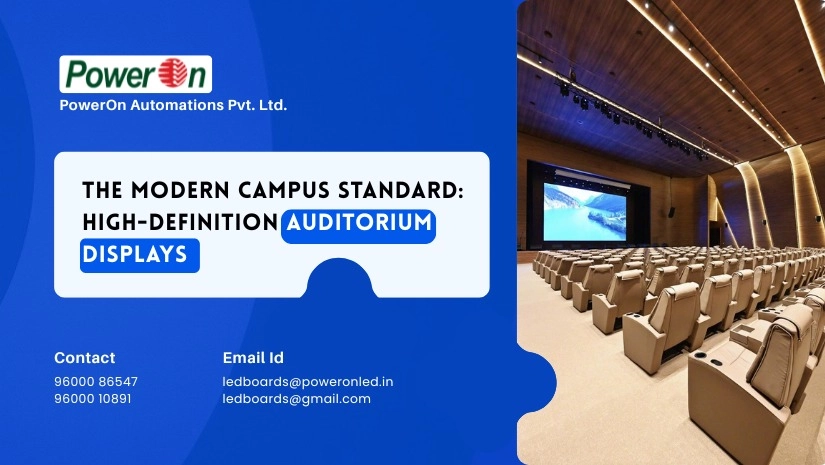
The traditional university auditorium is undergoing a massive evolutionary shift. For decades, massive lecture halls relied on static chalkboards, pull-down projection screens, and dim overhead projectors that required turning off the lights just to read a slide.
Today, higher education demands an immersive, high-impact learning environment. Modern students are digital natives who respond to sharp visuals, dynamic media, and collaborative learning. This cultural and technological shift has made the integration of an advanced indoor led screen display setup the gold standard for premier universities across the globe.
By replacing faded projectors with modular, bright, and interactive video walls, institutions are turning passive listening spaces into hotbeds of academic engagement and collaborative thought.
Why the Traditional Projector Fails in Large Lecture Halls
Before exploring the benefits of an indoor led screen display, it is worth looking at why standard projectors no longer make the grade in modern educational architecture:
- The Ambient Light Problem: Projectors require dark spaces. Blinds must be drawn and lights dimmed, which frequently results in students losing focus or struggling to take notes.
- Wasted Space and Shadows: Presenters are forced to stand away from the center of the stage to avoid blocking the projection beam or getting blinded by the lamp lens.
- Costly Bulb Replacements: High-end projector bulbs degrade quickly, lose color calibration over time, and carry substantial maintenance costs.
- Low Contrast Ratios: Complex technical diagrams, mathematical formulations, or dense medical imagery often look washed out on a standard projector fabric screen.
How an Indoor LED Screen Display Reinvents the Academic Experience
An indoor led screen display overcomes every single one of these structural bottlenecks. Utilizing ultra-fine pixel pitch technology, these screens provide crisp text and vibrant colors even when the auditorium house lights are turned up to full brightness.
1. Eliminating the "Back Row" Disadvantage
In a massive 500-seat university auditorium, students stuck in the back rows often struggle to see small text or fine details on a traditional display. A high-resolution indoor led screen display ensures that every single seat gets a front-row view. The superior brightness levels (measured in nits) and wide viewing angles maintain visual consistency from the edge of the front row right up to the top tier balcony.
2. True Seamless Interactivity
Modern education relies heavily on remote collaboration, hybrid learning modules, and real-time data analysis. A high-tier indoor led screen display system allows professors to seamlessly split screens, run live software simulations alongside slide presentations, host real-time guest speakers via crisp video conferencing feeds, and interact directly with content using touch-enabled overlays.
3. Multifunctional Campus Utility
University auditoriums are no longer reserved just for morning lectures. We are shared community spaces used for international research symposiums, student government debates, cinematic screenings, alumni fundraising galas, and placement orientation drives. The exceptional versatility of an indoor led screen display allows event organizers to switch themes, visual backdrops, and media layouts instantly at the click of a button.
Why Choose PowerOn LED for Your Indoor LED Screen Display Installation?
Upgrading an entire university auditorium infrastructure is a serious capital expenditure that requires technical precision and long-term hardware reliability. This is exactly why leading academic institutions trust PowerOn LED to orchestrate our digital transformations.
Pixel-Perfect Academic Clarity
At PowerOn LED, we engineer our indoor led screen display modules with premium-grade driver ICs and fine pixel pitches (such as P1.8 to P2.5), which are custom-optimized for close-to-medium range viewing in lecture environments. This guarantees that complex engineering drafts, microscopic medical slides, and small spreadsheet columns remain completely legible without causing pixelation or digital eye strain.
Official Certifications & Industrial Reliability
When you invest in PowerOn LED, you are choosing hardware that meets rigorous official quality benchmarks. Our display products proudly carry prestigious BIS, GEM, and Make in India certifications. These credentials verify that our hardware is engineered to withstand long operating hours while delivering consistent chromatic accuracy year after year.
Complete Plug-and-Play Control Systems
We understand that university professors are experts in our fields, not necessarily IT professionals. That is why our indoor led screen display architecture is built for everyday ease of use. We offer dual control systems:
- Offline Control: Update slide decks and announcements easily via USB drives, Wi-Fi, or direct mobile app connectivity.
- Online Synchronous Control: Stream live lectures, multi-source video streams, or high-definition audio-visual feeds flawlessly through LAN, HDMI, DVI, and SDI ports.
End-to-End Execution and Lifespan Value
From initial site surveys and architectural acoustics planning to custom structural installation and staff training, the team at PowerOn LED manages the entire lifecycle. With a phenomenal operational lifespan of over 50,000 to 100,000 hours and high energy-efficiency ratings, our screens drastically lower operational overhead while maximizing institutional return on investment (ROI).
Technical Comparison: Upgrading Your Campus Infrastructure
| Feature Set | Traditional Auditorium Projectors | PowerOn LED Indoor LED Screen Display |
|---|---|---|
| Visual Legibility | Requires low ambient room lighting; prone to fading. | Exceptional clarity in 100% bright ambient daylight. |
| Shadow Interruption | Presenters cast shadows when crossing the beam. | Self-emitting emissive technology; zero shadows cast. |
| Operating Lifespan | ~3,000 to 5,000 hours before bulb replacement. | Up to 100,000 hours of peak chromatic performance. |
| Input Versatility | Limited to standard single-source display cables. | Split-screen, multi-source, Wi-Fi, and app-driven control. |
| Maintenance Profile | High recurring costs for bulb swaps and filters. | Low maintenance with simple front-serviceable modules. |
FAQ: Smart Campus Displays
1: What is the ideal pixel pitch for a university auditorium indoor led screen display?
For typical university auditoriums where the front row of students sits at least 6 to 10 feet away from the stage, a fine pixel pitch ranging between P1.86 and P2.5 is ideal. PowerOn LED designs custom configurations that balance pixel density with your specific viewing distances, ensuring text remains sharp and highly legible from every angle.
2: How does a PowerOn LED indoor led screen display lower a university’s energy costs?
Unlike traditional commercial projection bulbs that dissipate massive amounts of energy as heat, our advanced indoor led screen display systems utilize energy-saving cathode technology and high-efficiency LED chips. This drastically reduces power consumption during long lecture hours, helping your campus meet its green sustainability goals while reducing monthly electricity bills.
3: Can professors operate an indoor led screen display without specialized technical training?
Absolutely. The display management systems designed by PowerOn LED feature intuitive user interfaces with straightforward plug-and-play functionality. Faculty members can easily cast our laptops, run presentations via a simple USB drive, or switch display sources using a smartphone app or wall-mounted control tablet without needing any background in IT administration.
4: How long does a premium indoor led screen display last under continuous daily campus use?
A high-tier indoor led screen display from PowerOn LED is engineered for high-frequency daily operation and has a rated lifespan of up to 100,000 hours. This translates to over a decade of reliable service for a university, offering significantly higher financial returns compared to projector systems that require frequent lamp replacements.
5: Is it possible to run multi-window split screens on an indoor led screen display during hybrid lectures?
Yes, our advanced video wall processors easily accommodate multi-source inputs. Instructors can display a PowerPoint presentation, run a live coding environment, and host a remote classroom feed via Zoom simultaneously on a single indoor led screen display canvas, making it an incredibly powerful asset for modern hybrid education.
