
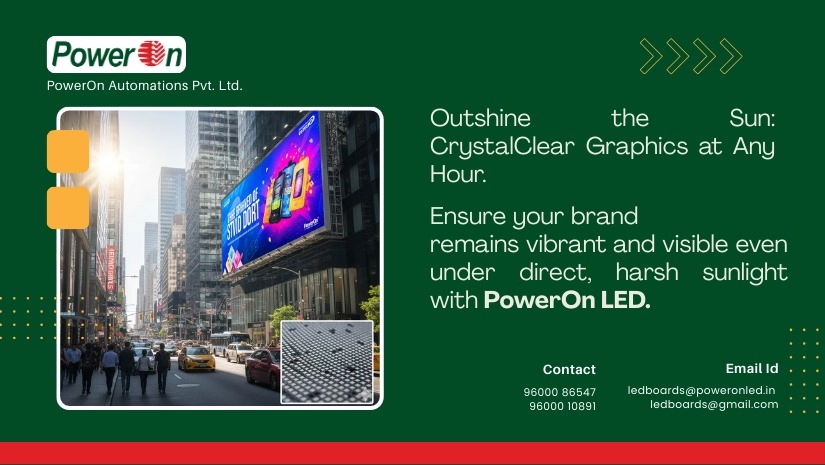
In the world of digital out-of-home (DOOH) advertising, the environment is the ultimate adversary. As we navigate the climate challenges of 2026, outdoor digital infrastructure is no longer just about displaying an image; it is about survival. From the searing heatwaves and dust storms of the Chennai coast to the freezing humidity of high-altitude regions, your hardware is under constant assault.
For businesses and media owners, the investment in outdoor led screen panels is significant. Therefore, ensuring 24/7 connectivity and operational uptime isn't just a technical requirement—it’s a financial one. If your screen goes dark during a storm or "washes out" during a heatwave, you aren't just losing visibility; you are losing revenue.
The Challenge: Why Typical Screens Fail Outdoors
Outdoor environments are unpredictable. Most standard displays fail due to three primary "silent killers":
- Thermal Stress: Intense sunlight can raise internal cabinet temperatures to over 70°C, causing "pixel death" or automatic shutdowns.
- Moisture Ingress: Humidity and salt-heavy air in coastal areas corrode internal circuitry, leading to flickering and short circuits.
- Particulate Clogging: Dust and pollutants clog traditional cooling fans, leading to overheating and mechanical failure.
To overcome these, 2026 technology has shifted toward "Ruggedized Intelligence," where the display is built to breathe and survive in any atmosphere.
Why Choose PowerOn LED for the Outdoor LED Screen Panels?
When reliability is non-negotiable, PowerOn LED stands as the industry benchmark. We don't just build screens; we build armored visual communication systems. Here is why global brands and local entrepreneurs trust PowerOn LED for our outdoor led screen panels:
1. IP67-Rated Total Protection
While many competitors stop at IP65, PowerOn LED offers advanced IP67-rated modules. This means our outdoor led screen panels are not just "splash-proof"—we are completely sealed against fine dust and can withstand temporary immersion in water. Whether it's a monsoon downpour or a sandstorm, the internal electronics remain bone-dry and dust-free.
2. High-Brightness "Sun-Cutter" Technology
Visibility is the soul of outdoor advertising. Our panels deliver a staggering 8,000 to 10,000 nits of brightness. Unlike standard displays that look faded at noon, PowerOn LED panels use high-contrast masks and anti-reflective coatings to ensure your content remains vivid and eye-catching, even under direct, harsh sunlight.
3. Intelligent Climate Management
Our 2026 series features a "Fanless Heat Dissipation" design. By using high-thermal-conductivity aluminum cabinets, we dissipate heat naturally. This prevents the "vacuum effect" that sucks in dust and moisture, ensuring that our outdoor led screen panels function perfectly in temperatures ranging from -30°C to +60°C.
4. Common Cathode Energy Efficiency
Operating a massive outdoor screen can be expensive. PowerOn LED utilizes Common Cathode technology, which precisely supplies voltage to the Red, Green, and Blue LEDs separately. This reduces heat generation by 25% and cuts power consumption by up to 30%, making your installation both sustainable and more profitable.
The 24/7 Connectivity Factor: Remote Diagnostics
In 2026, you shouldn't need a technician on a ladder to check a screen’s health. Every PowerOn LED installation comes with an Integrated Health Monitoring System. Our cloud-based dashboard provides real-time data on:
- Internal temperature and humidity levels.
- Power supply stability.
- Pixel-level failure detection.
- Ambient light sensing for automatic dimming.
This proactive approach ensures that if a storm is coming or a power surge occurs, the system can protect itself automatically, maintaining that crucial 24/7 connectivity.
Frequently Asked Questions (FAQ)
1. What is the best pixel pitch for outdoor led screen panels on a highway?
For high-speed highway billboards where the viewing distance is usually over 50 meters, a pixel pitch of P8 or P10 is ideal. However, for urban roadside displays where pedestrians are closer, PowerOn LED recommends P4 or P5 to maintain high-definition clarity.
2. How do PowerOn LED panels handle salt-air corrosion in coastal cities?
Coastal environments are the toughest on electronics. PowerOn LED uses specialized anti-corrosion coatings (Conformal Coating) on all PCBs and marine-grade stainless steel fasteners. Our aluminum alloy cabinets are naturally resistant to rust, ensuring a lifespan of over 10 years even in salty air.
3. Are outdoor led screen panels difficult to maintain in rainy weather?
Not if they are designed correctly. Our panels feature Front and Rear Serviceability. With a vacuum suction tool or a simple magnetic key, individual modules can be replaced in under 2 minutes. The sealed design ensures that even if you perform maintenance during a drizzle, the internal components remain protected.
4. What is the power consumption of a standard 10x20ft outdoor screen?
On average, our energy-efficient outdoor led screen panels consume about 250–350 watts per square meter. With our 2026 "Eco-Save" mode, the screen automatically dims at night, significantly reducing your monthly electricity bill compared to older LED technologies.
5. Can PowerOn LED screens show 3D anamorphic content?
Yes! We specialize in Curved Corner LED displays that are perfect for "Naked-Eye 3D" content. Because our panels have a high refresh rate of 3840Hz or higher, the 3D effect remains smooth and flicker-free, even when captured on smartphone cameras by passersby.
